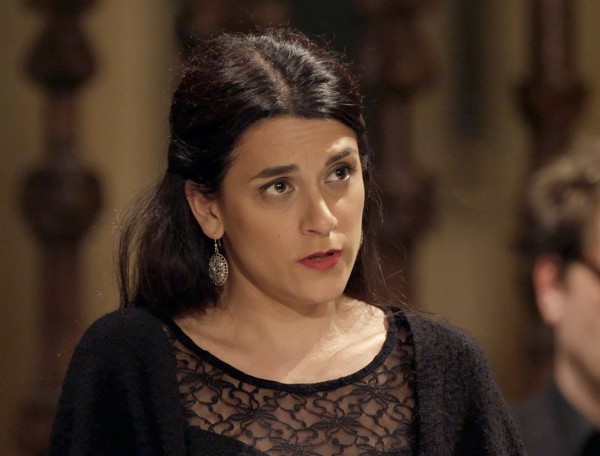

Mein Herze schwimmt in Blut
BWV 199 performed by the Netherlands Bach Society
conducted by Alfredo Bernardini
Walloon Church, Amsterdam
Behind the music
Story
Story
Extra videos
Extra videos
Texts
Texts
Credits
Credits
Italian drama
In 24 minutes, the mood changes from one of deepest misery to one of wildest joy
Although in his younger years Bach was seen mainly as an organ virtuoso, his ambitions really lay elsewhere. His goal was to set up no less than ‘eine regulirte Kirchen-Music zu Gottes Ehren’, as he wrote in 1708 in his letter of resignation to his employers in Mühlhausen. He appeared to get the chance to do so at the court of Duke Wilhelm Ernst of Weimar. But to his dissatisfaction, the emphasis lay once again on his qualities as an organist and chamber musician in his first six years there. As in Mühlhausen, he hardly got round to composing cantatas, and the words of the works he did write in this period were taken mainly from the Bible, as was customary at the time.
This changed drastically in 1714, the year in which he was at last promoted by Duke Wilhelm Ernst to Konzertmeister. Bach immediately started using a much more modern style, breaking with the tacit obligation of using only biblical texts and hymns, and with the custom of setting them to music in a fairly formal way. His innovative approach was inspired by the new collections of spiritual poems that were starting to appear here and there, such as those published by chief librarian Georg Christian Lehms from Darmstadt, in 1711. For the musical setting of his heartrending Mein Herze schwimmt in Blut, Bach chose a succession of expressive recitatives and da capo arias in Italian style.
This cantata is about the transformation from supreme sinfulness via penance to redemption. The explicit words that describe the suffering and despair of humanity are made almost physically tangible by the music. In the first tormented recitative, followed by the heartrending da capo lament ‘Stumme Seufzer, stille Klagen’, an important role has been set aside for the mournful oboe. It is only after this that Bach allows the faithful to humbly turn to God in a short recitative and once again a da capo aria. The forgiveness bestowed by God is expressed in the hopeful chorale, in which he interweaves the chorale melody for the soprano with an unusual elevated melody for viola solo (a practically unique occurrence in Bach’s music). Only after this does the believer place his soul in the hands of the Lord, accompanied by a jubilant oboe.
Extra videos
Soprano Julia Doyle
"This piece is an emotional struggle: keeping completely engaged emotionally, at every moment in the text."
Vocal texts
Original
1. Rezitativ
Mein Herze schwimmt im Blut,
weil mich der Sünden Brut
in Gottes heilgen Augen
zum Ungeheuer macht.
Und mein Gewissen fühlet Pein,
weil mir die Sünden nichts
als Höllenhenker sein.
Verhasste Lasternacht!
Du, du allein
hast mich in solche Not gebracht;
und du, du böser Adamssamen,
raubst meiner Seele alle Ruh
und schliessest ihr den Himmel zu!
Ach! unerhörter Schmerz!
Mein ausgedorrtes Herz
will ferner mehr kein Trost befeuchten,
und ich muss mich vor dem verstecken,
vor dem die Engel selbst
ihr Angesicht verdecken.
2. Arie und Rezitativ
Stumme Seufzer, stille Klagen,
ihr mögt meine Schmerzen sagen,
weil der Mund geschlossen ist.
Und ihr nassen Tränenquellen
könnt ein sichres Zeugnis stellen,
wie mein sündlich Herz gebüsst.
Mein Herz ist itzt ein Tränenbrunn,
die Augen heiße Quellen.
Ach Gott! wer wird dich doch zufriedenstellen?
3. Rezitativ
Doch Gott muss mir genädig sein,
weil ich das Haupt mit Asche,
das Angesicht mit Tränen wasche,
mein Herz in Reu
und Leid zerschlage
und voller Wehmut sage:
Gott sei mir Sünder gnädig!
Ach ja! sein Herze bricht,
und meine Seele spricht:
4. Arie
Tief gebückt und voller Reue
lieg ich, liebster Gott, vor dir.
Ich bekenne meine Schuld,
aber habe doch Geduld,
habe doch Geduld mit mir!
5.Rezitativ
Auf diese Schmerzensreu
fällt mir alsdenn dies Trostwort bei:
6. Chorale
Ich, dein betrübtes Kind,
werf alle meine Sünd,
so viel ihr in mir stecken
und mich so heftig schrecken,
in deine tiefen Wunden,
da ich stets Heil gefunden.
7.Rezitativ
Ich lege mich in diese Wunden
als in den rechten Felsenstein;
die sollen meine Ruhstatt sein.
In diese will ich mich im Glauben
schwingen und drauf vergnügt
und fröhlich singen:
8. Arie
Wie freudig ist mein Herz,
da Gott
versöhnet ist
und mir auf Reu und Leid
nicht mehr die Seligkeit
noch auch sein Herz verschliesst.
Translation
1. Recitative
My heart floats in [congested] blood,
Because sin’s brood
Makes me into a monster
In God’s holy eyes;
And my conscience feels pain,
Because sins, to me, are nothing
But hell’s executioners.
Hateful vice’s night,
You, you alone
Have brought me into such distress;
And you, you evil seed [sown in the heart] of Adam,
Rob my soul of all rest
And close [“rainfall” from] heaven to it [my soul].
Ah, unheard-of agony!
Henceforward no consolation will water
My dried-up heart,
And I must hide myself from him [God],
Before whom even the angels
cover their faces.
2. Aria and Recitative
Mute sighs, silent lamentations,
You may speak of my agonies,
Because my mouth is closed.
And you wet springs of tears
Can give sure witness
Of how my sinful heart has repented.
My heart is now a well of tears,
My eyes hot springs.
Ah, God, who will yet satisfy you?
3. Recitative
Yet God must be gracious to me,
Because I wash my head with ashes
[And] my countenance with tears,
[And because I] shatter my heart
in remorse and suffering
And say, full of melancholy:
“God, be gracious to me the sinner.”
Ah, yes, his heart breaks [for me],
And my soul says:
4. Aria
Deeply bent over and full of remorse
I lie, dearest God, before you.
I acknowledge my guilt,
But [may you] yet have patience,
Yet have patience with me.
5. Recitative
Then, upon this aching remorse,
This word of consolation comes to mind:
6. Chorale
I, your [Jesus’s] dejected child,
Cast all my sins,
So many of them as stick fast within me
And frighten me so grievously,
Into your deep wounds,
Where I have always found salvation.
7. Recitative
I lay myself into these wounds
As into [Christ] the proper quarry stone;
They [the wounds] shall be my place of rest.
Into these [wounds] will I,
in [Christian] belief, fling myself
And thereupon contentedly and cheerfully sing:
8. Aria
How joyful is my heart,
Because God is reconciled
[to the sinner by Christ’s wounds];
And [because] after [my] remorse and suffering,
[God] will not any longer close [eternal] blessedness
Or his heart to me.
transl. © Daniel R. Melamed and Michael Marissen
For the annotated version of the text and translation, see here.
Credits
-
- Release date
- 31 October 2014
-
- Recording date
- 8 June 2014
-
- Location
- Walloon Church, Amsterdam
-
- Oboe and direction
- Alfredo Bernardini
-
- Soprano
- Julia Doyle
-
- Violin 1
- Shunske Sato
-
- Violin 2
- Cecilia Bernardini
-
- Viola
- Staas Swierstra
-
- Cello
- Lucia Swarts
-
- Double bass
- Robert Franenberg
-
- Bassoon
- Benny Aghassi
-
- Harpsichord
- Siebe Henstra
-
- Church organ
- Leo van Doeselaar
-
- Concert production
- Marco Meijdam, Imke Deters
-
- Producer
- Zoë de Wilde, Frank van der Weij
-
- Film director
- MaNOj Kamps, Onno van Ameijde, Jasper Verkaart
-
- Director of photography
- Sal Kroonenberg
-
- Camera
- Jorrit Garretsen, Joris Kerbosch, Sal Kroonenberg
-
- Film editors
- Jasper Verkaart, MaNOj Kamps, Frank van der Weij
-
- Music recording producer
- Leo de Klerk
-
- Gaffer
- Harm Bredero, Alban Riphagen
-
- Music recording assistants
- Jaap Firet, Pim van der Lee, Jaap van Stenis, Bobby Verbakel
-
- Make up
- Marloes Bovenlander, Jamila el Bouch
-
- Camera assistant
- Izak de Dreu
-
- Music edit and mix
- Leo de Klerk, Frank van der Weij
-
- Music edit and mix asssistant
- Martijn Snoeren
-
- Colorist
- Marlieke Kasten
-
- Acknowledgements
- Nienke Meuleman

Help us to complete All of Bach
There are still many recordings to be made before the whole of Bach’s oeuvre is online. And we can’t complete the task without the financial support of our patrons. Please help us to complete the musical heritage of Bach, by supporting us with a donation!